The Cardinal
Pat Tillman left a multimillion-dollar NFL contract to become an Army Ranger — and refused to explain himself to anyone. The truth about how he died took the country years to learn.

THE FALLEN AND THE FINAL FOUR · A MEMORIAL DAY SERIES
PART 4 OF 8
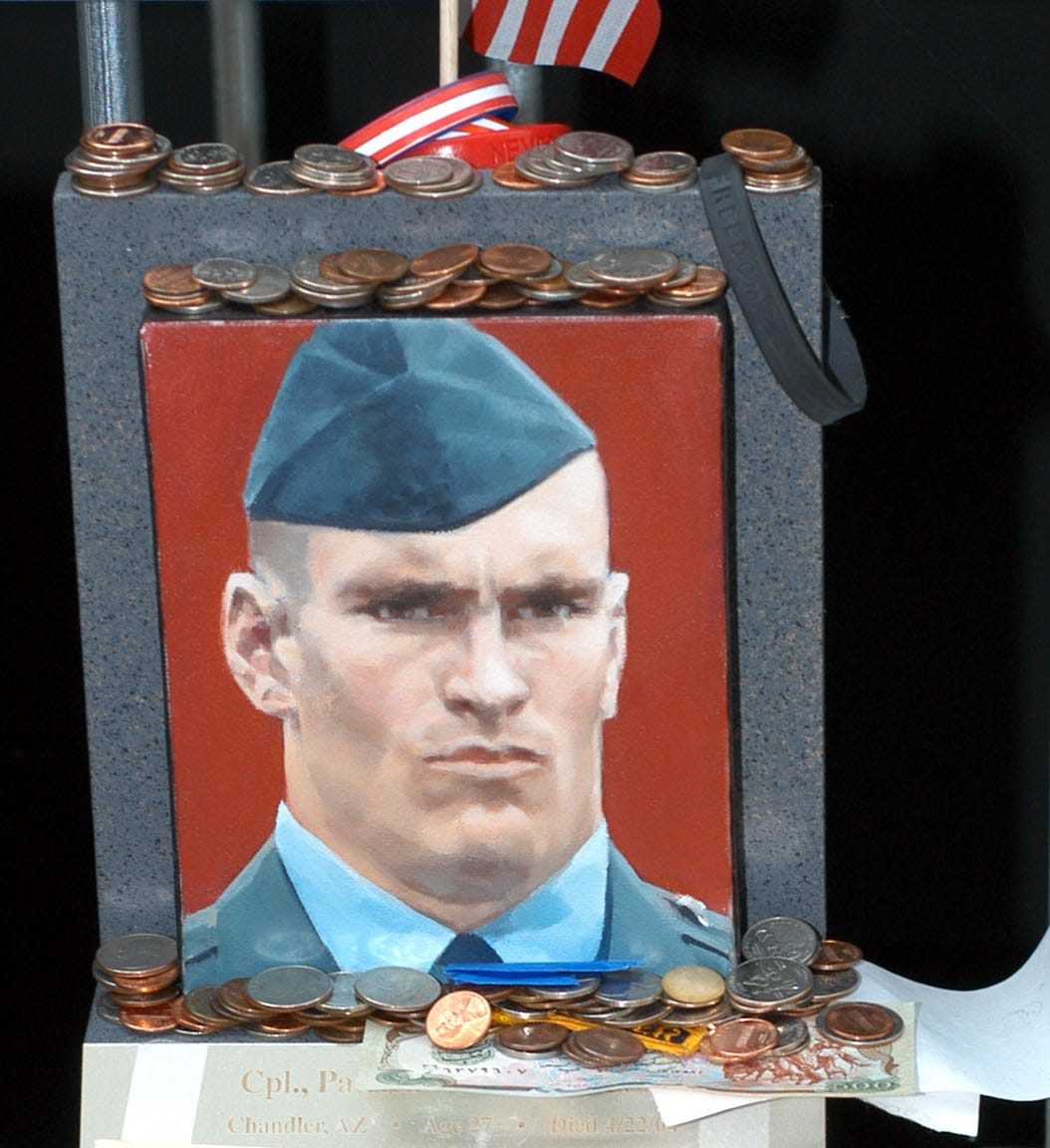
Probably the most famous portrait of the fallen is former National Football League star Pat Tillman, 27, who gave up the glamorous life of a professional football star to join the Army Rangers. He was killed in Afghanistan on April 22, 2004. Natasha Mokina painted his portrait at the "Faces of the Fallen" exhibit on display at the Women in Military Service to America Memorial in Arlington, Va.. Photo by Rudi Willia.
Pat Tillman did not look like a professional athlete, and he did not behave like one, and that, in a sense, was the whole point of him.
He was born in 1976 and raised in the Almaden Valley, a leafy corner of San Jose, California, the oldest of three boys. His mother, Mary, was a schoolteacher; his father, Patrick, a lawyer. The Tillman household prized independence, argument, physical courage and books in roughly equal measure, and it produced in Pat a young man nearly incapable of doing a thing simply because he had been told to.
He was not, at first, a football star. As a freshman at Leland High School he was a baseball catcher who failed to make the varsity. He turned to football as a sophomore, threw his whole body into it, and helped lead Leland to a Central Coast Section championship. He was lightly recruited — too small, the scouts said, too slow for his own ambitions — and Arizona State took a chance on him with the last scholarship it had to give that year.
The Last Scholarship
At Arizona State, Tillman refused to be redshirted, reportedly informing the coaching staff that he intended to graduate in four years and would not be sticking around for a fifth. He did it in three and a half — a degree in marketing, a 3.85 grade-point average — and in 1997 he was named the Pac-10 Conference Defensive Player of the Year as the Sun Devils went undefeated in the regular season and reached the Rose Bowl.
The NFL was, once again, skeptical. The Arizona Cardinals selected him in the seventh round of the 1998 draft, the 226th player chosen. Tillman simply outworked the verdict. In 2000 he set a Cardinals franchise record with 224 tackles. When the St. Louis Rams later offered him a five-year contract worth a reported $9 million, he turned it down and stayed in Arizona, out of loyalty to the team that had taken a chance on him.
In the aftermath of the September 11 attacks, Tillman spoke to an NFL Films camera in words that, in hindsight, read like a hinge swinging in his life. His relatives had answered America’s wars going back generations, he said, and measured against them he had not yet been truly tested. “I haven’t done a damn thing,” he said, “as far as laying myself on the line like that.”
If you value longform stories about sports, history, sacrifice and the lives behind the headlines, consider subscribing to Short Shot Media. It’s free and every subscription helps us continue telling stories like this.
Walking Away
In the spring of 2002, Pat Tillman declined a new contract from the Cardinals worth a reported $3.6 million and enlisted in the United States Army — alongside his brother Kevin, who gave up a professional baseball career to do exactly the same. Both men became Army Rangers.
What set Tillman apart was not only the size of what he surrendered but his absolute refusal to be celebrated for surrendering it. He resisted nearly every attempt to turn his decision into a publicity campaign. He did not want to be a recruiting poster or a symbol or an inspiration; he wanted to be a soldier, anonymous in the ranks, and he was visibly uncomfortable whenever anyone tried to make him into something grander.
Friends later described a man far more intellectually restless and politically independent than the public image that emerged after his death — a voracious reader who had allegedly begun questioning aspects of the wars he was fighting in even as he continued serving in them.
He served in the 2003 invasion of Iraq and then deployed to Afghanistan.
The Canyon
On April 22, 2004, in rugged canyon country in southeastern Afghanistan, Tillman’s Ranger platoon was split into two sections in confusing terrain following an enemy contact. In the chaos and the failing light, one element of his own platoon fired on the other. Pat Tillman was killed by that fire. He was 27 years old.
He was given a nationally televised memorial service and a posthumous Silver Star, and the country was told that he had died charging toward the enemy. It was not true, and parts of the Army knew it was not true.
Five weeks after his death, the Tillman family was formally informed that Pat had been killed by friendly fire — fratricide — and that the earlier account had been false. Investigations by the Army, by the Pentagon’s inspector general and by Congress followed. They documented serious battlefield failures and, more damningly, a failure to tell his family and the public the truth in an honest and timely way. Tillman’s mother, Mary, spent years pressing for answers, and later wrote a book about the ordeal.
The Plain Truth
The particular cruelty of the cover-up is that Pat Tillman never needed embellishing. He had walked away from fame and money to carry a rifle precisely because he distrusted the easy, glittering version of a life. The plain, unedited facts of him were always more than enough.
His family built the Pat Tillman Foundation, which invests in veterans and military spouses through its Tillman Scholars program, funding their education and their development as leaders. Every spring, tens of thousands of people run Pat’s Run in Tempe — a race 4.2 miles long, for the No. 42 that Arizona State retired in his honor. Each year, ESPN presents a Pat Tillman Award for Service.
Tillman did not play lacrosse; his game was football, and then it was no game at all. But he belongs in any honest accounting of American athletes who became soldiers, because he understood — more clearly, perhaps, than anyone else in this series — the exact distance between the two.
One is a game. The other is not.
He left the first for the second with his eyes wide open, and asked for nothing in return. Not even, it turned out, the truth — which his country owed him, and was shamefully slow to pay.
This Memorial Day Series includes others like Lieutenant Michael Murphy — the Long Island Navy SEAL later immortalized in Lone Survivor — and Brendan Looney, the Navy lacrosse captain whose teammates still carry his memory onto the field each spring. Other stories in the series will be released later today and throughout tomorrow. Different uniforms. Different wars.
And if you would like to support independent storytelling that remembers heroes like them please consider subscribing (it’s free) to Short Shot Media and sharing this Series with others this Memorial Day weekend.