The Machine
Lt. Raymond Enners died in Vietnam at 22, trying to reach a wounded soldier across open ground. Each spring, college lacrosse’s highest individual honor is handed to a new player under his name.

THE FALLEN AND THE FINAL FOUR · A MEMORIAL DAY SERIES
PART 7 OF 8
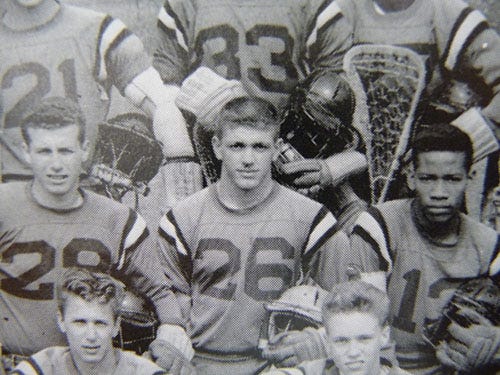
Photo From Suffolk County Ray Enners Award Website
Please consider Subscribing to Short Shot Media (it’s free) to support storytelling that remembers the athletes, servicemen and forgotten moments history should never lose.
His teammates called him “the Machine,” and on Long Island in the early 1960s that was no small thing to be called. Long Island was then — and remains now — the densest concentration of lacrosse talent in the United States, a place where the sport is woven straight into the public schools, the backyards and the local sense of who people are. To be the best player on a Long Island field was to be among the best players anywhere the sport was played. Raymond Enners was that good.
He was born in 1945 and raised in Farmingdale, and he came up in the game the way Long Island boys do — early, constantly, and in deadly earnest. He played his schoolboy lacrosse at Half Hollow Hills High School, in Dix Hills, in the heart of Suffolk County, where he was a champion and a standout, known to friends by the affectionate nickname “Iggy.” His ability earned him an appointment to the United States Military Academy at West Point — and West Point is not merely a place. It is a decision about how a life is to be spent.
West Point and Vietnam
At Army, Enners was a three-year letterman and, in 1967, an honorable-mention All-American — a fixture on a strong program, fast and skilled and, as the nickname had promised, relentless. He graduated with the West Point class of 1967 and was commissioned an officer of infantry.
It was not an abstract moment to become a young infantry lieutenant. The class of 1967 walked off the Plain at West Point and directly into the Vietnam War at its height. In those years, West Point athletics and military service were inseparable realities. Many of the country’s best college athletes graduated straight into combat zones overseas.
Enners went where his training and his commission sent him — to South Vietnam, as a platoon leader.
On September 18, 1968, near the village of Ha Thanh, Enners’s unit — part of the Americal Division — was moving through contested ground when one of his men was severely wounded and fell roughly twenty meters from enemy positions. The wounded soldier called out for help. Lieutenant Raymond Enners went after him — across open ground, into heavy enemy fire — to try to bring him back.
He did not survive the attempt. He was 22 years old.
For his actions that day he was posthumously awarded the Distinguished Service Cross — the nation’s second-highest decoration for valor — along with the Bronze Star and the Purple Heart.
One Class, One War
Enners was not the only lacrosse player in his West Point class to die in Vietnam that year. His classmate Michael Nathe, who both played lacrosse and wrestled at the academy, volunteered for Vietnam as his very first assignment out of West Point and was killed in 1968 as well; he was awarded the Silver Star. Two young men, two sticks, one graduating class, one war, one year.
Their names live on now on the same building.
In 2016, West Point opened the Foley, Enners, Nathe Lacrosse Center — a home for Army’s men’s and women’s lacrosse teams, named for Enners, for Nathe and for their surviving classmate William Foley, later the businessman and sports owner Bill Foley, who funded it as a tribute to the friends he had lost. Army’s players dress for practice every day inside a memorial to two of their own.
Enners’s brother, Richard, later wrote a book about him, Heart of Gray, so that the full texture of a short life would not blur down into a date and a list of medals. And Long Island, which had made him, later enshrined him in the Suffolk County Sports Hall of Fame.
Please consider Subscribing to Short Shot Media (it’s free) to support storytelling that remembers the athletes, servicemen and forgotten moments history should never lose.
Memorial Day Weekend
But the most far-reaching tribute of all belongs to the entire sport.
Since 1969 — the year after he was killed — the Lt. Raymond Enners Award has been presented to the outstanding player in Division I men’s lacrosse. It is the highest individual honor the college game has to offer, the prize that every great player covets, and it is handed out each spring during championship weekend.
The timing is not accidental. The award bearing Enners’s name is presented during Memorial Day weekend itself — at the very moment the sport gathers to celebrate its champions. The game’s greatest individual honor arrives wrapped inside the memory of a lieutenant who never came home from war.
Many of the young men who win the award today are roughly the same age Enners was when he died.
Consider, for a moment, what that means.
Every year, in front of a roaring Memorial Day crowd, the finest lacrosse player in America steps forward to accept an award — and the award carries the name of a 22-year-old lieutenant who spent the final moments of his life trying to drag a wounded man out of the open. The player of the year and the platoon leader are bound together permanently, the one holding the trophy, the other’s name engraved upon it.
There is no shorter or truer course in what this weekend is actually for.
If you’ve been following The Fallen and the Final Four, please consider restacking or sharing the series so more readers can discover these stories of athletes, war, sacrifice and remembrance. Independent journalism survives because readers pass it forward.