The Two Towers
Welles Crowther tied a red bandana over his face and climbed back up into the fire. Eamon McEneaney had once led dozens to safety. On September 11, 2001, the lacrosse world lost two of its own.

THE FALLEN AND THE FINAL FOUR · A MEMORIAL DAY SERIES
PART 8 OF 8
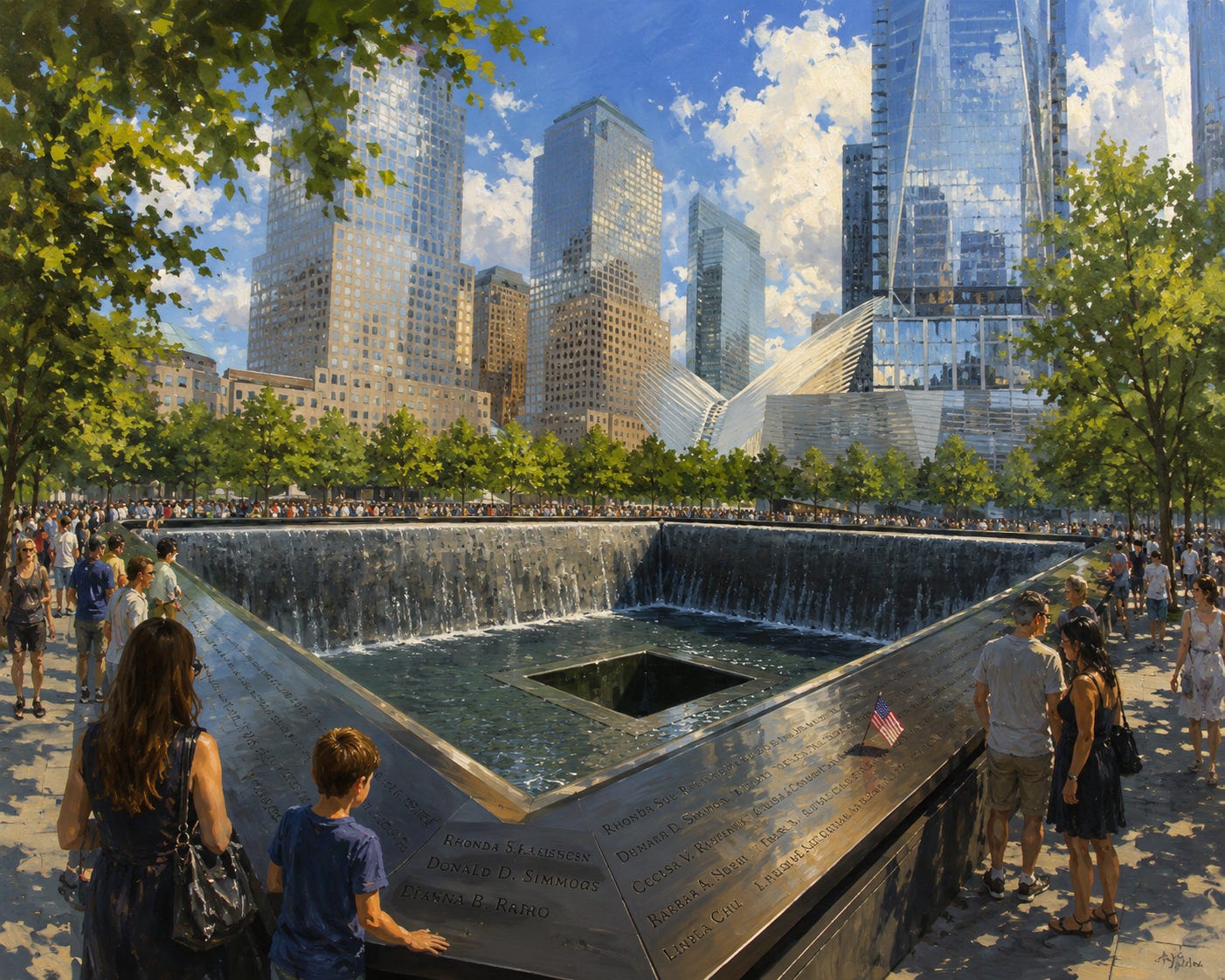
They never met, as far as anyone knows. They were a generation apart; they played for rival universities; they worked in different towers. But Welles Crowther and Eamon McEneaney were bound together first by a game and then by a single morning, and so their stories belong together.
The Man in the Red Bandana
Welles Crowther grew up in Nyack, New York, a river town on the Hudson, and when he was six years old his father gave him a red bandana. It became a fixed feature of the boy. He kept one in his pocket; he wore one under his helmet when he played sports.
He played lacrosse and hockey at Nyack High School, and he went on to play lacrosse at Boston College — a tough, undersized defender and midfielder with, by every account, an outsized appetite for being useful to other people.
There was a second thread running through his boyhood. His father was a volunteer firefighter, and Welles followed him into it, joining the local company as a teenager. He grew up understanding, in a way most children never have to, that when a building is burning there are people whose duty is to run toward it.
After Boston College, Crowther took a job as an equities trader at Sandler O’Neill, on the 104th floor of the South Tower of the World Trade Center. He was 24 years old on the morning of September 11, 2001, when United Airlines Flight 175 struck the building beneath him.
What Crowther did over the next hour was reconstructed only later, slowly, and entirely from the accounts of the people who lived because of it.
He made his way down to the 78th-floor sky lobby — a scene of wreckage, smoke, and wounded and disoriented survivors. There, a young man with a red bandana tied over his nose and mouth took command. He pointed people toward the stairs. He beat out fires. He carried a badly injured woman down seventeen floors — and then, against every instinct of self-preservation, he went back up. And then he did it again. He was last seen climbing back up into the tower.
Welles Crowther died when the South Tower collapsed. His remains were recovered the following March, in the lobby, alongside firefighters and rescue personnel — he had spent the last minutes of his life among the people running toward the danger, exactly as his father had taught him.
For months, his family knew none of this. Then his mother, Alison, read survivors’ accounts of a calm young man in a red bandana who had led them out — and she knew her son.
He is widely credited with helping save as many as eighteen people from the South Tower.
If these stories matter to you, subscribe to Short Stop Media — it’s free — and help us continue telling stories about courage, memory, sports, history, and the lives too many people forget.
In 2006 the New York City Fire Department named him an honorary firefighter. In 2014, President Obama told his story at the dedication of the National September 11 Memorial Museum. Boston College now holds its annual “Red Bandana Game” in his honor, and the bandana itself has become a national shorthand for selfless courage.
One of Crowther’s red bandanas is on permanent display at the National September 11 Memorial & Museum.
And now, nearly twenty-five years after September 11, Crowther’s story is receiving another extraordinary recognition. Last week, President Donald Trump announced that Welles Crowther will posthumously receive the Presidential Medal of Freedom, the nation’s highest civilian honor, ahead of the 25th anniversary of the attacks.
It is difficult to imagine a more deserving recipient.
Cornell’s Wild Irish Rose
Eamon McEneaney was, by a great many expert estimates, the most gifted lacrosse player Cornell University has ever had — and Cornell has had a great many.
He was the youngest of seven children in a large Irish-Catholic family, raised on Long Island, and he came up through the schoolboy game there, at Sewanhaka High School, before he ever arrived in Ithaca.
From 1975 through 1977 he was a three-time first-team All-American, the engine of a Cornell team that won national championships in 1976 and 1977 and went undefeated across both seasons.
Ambidextrous, ferociously competitive, blessed with a shot opponents still describe with something close to awe, he was the finest player of his era, and he is still spoken of at Cornell with a reverence usually reserved for the founders of things.
He was also, unusually for a lacrosse immortal, a poet — a man who loved Irish history and language, and who wrote seriously throughout his life.
After college he nearly made the New York Jets’ roster as a punt returner before choosing finance instead.
McEneaney went into finance and rose to a senior position at Cantor Fitzgerald, the bond-trading firm whose offices occupied the upper floors of the North Tower of the World Trade Center.
He had already been inside that building for catastrophe once before.
In February 1993, when terrorists detonated a truck bomb beneath the towers, McEneaney led roughly sixty colleagues down through black, smoke-filled stairwells to safety, organizing them into a human chain — wetting paper towels for their faces and performing head counts at each landing so that no one would be lost in the darkness.
He got them all out.
Afterward, according to several accounts, he told friends he did not expect to survive if the towers were ever attacked again.
On September 11, 2001, American Airlines Flight 11 struck the North Tower below Cantor Fitzgerald’s offices. No one above the impact zone survived. Cantor Fitzgerald lost 658 employees that morning — the heaviest toll suffered by any single company on September 11.
Eamon McEneaney was 46 years old. He left behind his wife Bonnie and four children.
Cornell retired his No. 10. His family and the university later published a collection of his poems, A Bend in the Road. He remains a member of the National Lacrosse Hall of Fame.
Cornell also established the Eamon McEneaney Memorial Reading Series, which brings an Irish or Irish-American literary figure to campus each year.
What the Game Taught Them
The lacrosse community lost many of its own on September 11 — players, coaches, parents, alumni, and former teammates scattered throughout the financial firms of Lower Manhattan.
But Crowther and McEneaney are the two the game keeps returning to because their lives rhymed so precisely.
Each had learned, on a lacrosse field, a particular and unglamorous discipline: that when something goes catastrophically wrong, you do not freeze, and you do not bolt, and you do not think of yourself first — you find the people who need help, and you get them out.
Lacrosse demands split-second decisions, constant communication, and putting the team first even when chaos erupts; those same instincts proved decisive when real lives were on the line.
Eamon McEneaney had already done it once and saved sixty lives.
Welles Crowther did it until the building came down around him.
They were lacrosse players. They had practiced courage in the small, bounded, survivable way that a game allows. And when the morning finally came that demanded the real and unbounded thing, neither of them had to stop and decide who he was going to be.
If you’ve followed this Memorial Day series, please consider subscribing free to Short Stop Media and restacking or sharing these stories so the names and lives behind them continue to be remembered.
The Fallen and the Final Four
This concludes The Fallen and the Final Four, Short Stop Media’s Eight-Part Memorial Day Series on athletes and servicemen the country lost far too young — including Navy SEALs Michael Murphy and Brendan Looney, Pat Tillman, Jimmy Regan, Raymond Enners, Welles Crowther, Eamon McEneaney, and others whose stories still echo decades later.
Memorial Day eventually passes. The parades end. The flags are folded away.
But memory is also a form of duty — so that we may never repeat the mistakes of the past.
And perhaps that is what Memorial Day is really all about…